Pump foil technique & efficiency
Efficient pump foiling: more glide, less effort
Long pump foil runs do not come from maximum effort. What matters is to build speed first and then add only as much energy as the foil loses. Here you can see how pump amplitude, rhythm, body position and setup work together.
Speed first, efficiency second
Hydrodynamic lift rises roughly with the square of speed. After the start, use a few larger full-body movements. Once height and speed are stable, reduce the amplitude. The aim is not maximum ride height, but a lot of distance with little loss of height.
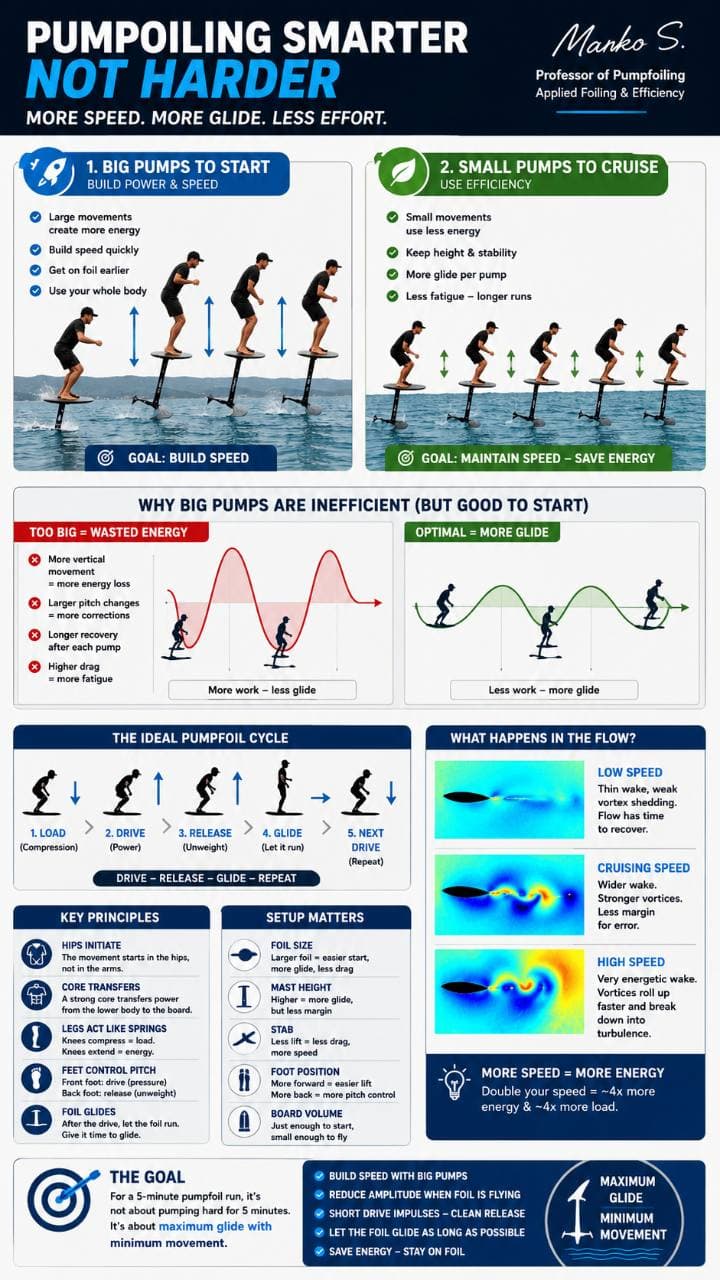
The efficient pump cycle
- Load: Ankles, knees and hips compress together; the upper body stays calm.
- Drive: The hips start a short impulse, and the core and legs pass it on to the board.
- Release: Let go of the pressure, and unweight the back leg in particular.
- Glide: Let the foil run as long as height and speed carry it.
- Next pump: Add the next impulse before the foil gets too low or too slow.
The most common brake on efficiency is a continuous up-and-down movement with no unloading phase. Think in drive – release – glide. The feet control pitch, while the hips and core pass on the impulse.
Four riding styles, four learning signals
There is no single perfect style. A calm rider scores with pitch control, but may transfer too little energy through the hips and core. A powerful rider accelerates quickly, but wastes energy in cruise mode with too large an amplitude. Reactive riders control the foil well, but often create side movements with their arms and upper body. The most efficient result is usually a combination of calm, drive, reaction and flow.
How to analyze your pump efficiency
Ride height
Does the foil stay in the middle range, or do you swing strongly between the water surface and the depth of the mast?
Amplitude
Does the movement get smaller after you have accelerated? Large swings at speed cost energy.
Glide share
Measure how long the foil runs freely and how much distance you cover per pump, not just the number of pumps.
Side movement
Check on video whether your arms and upper body secure your balance or swing unnecessarily.
A drill for your next session
- Plan three short runs with an unchanged setup.
- Ride run 1 normally and film it from the side as a reference.
- In run 2, deliberately reduce the pump amplitude after the start.
- In run 3, only focus on a clear release and longer glide phases.
- Compare distance, number of pumps, rhythm and perceived effort.
With SessionSpot you can coordinate comparison sessions: add a date, find riders to join, have someone film and swap observations right at the spot. A second perspective is often more valuable for technique training than yet more solo attempts. The app itself is currently available in German only.
Plan your next pump foil session (German app)Frequently asked questions
Why are small pumping movements more efficient on longer pump foil runs?
Once the foil is flying fast and stable, small impulses only replace lost energy. Large movements then create unnecessary changes in height, drag and corrections.
How fast should I pump when pump foiling?
There is no universal frequency. The right cadence depends on foil, mast, board, body weight and speed. What matters is an even rhythm and a real glide phase.
What is the fastest way to improve my pump foil technique?
Film short sequences, watch ride height, amplitude and glide duration, and change only one factor per session. That way you can tell which adjustment actually works.
Related guides
Pump foil technique · Pump and glide drill · Pump foil setup